
Choosing Our Degrees
Let's Invest in Our Future

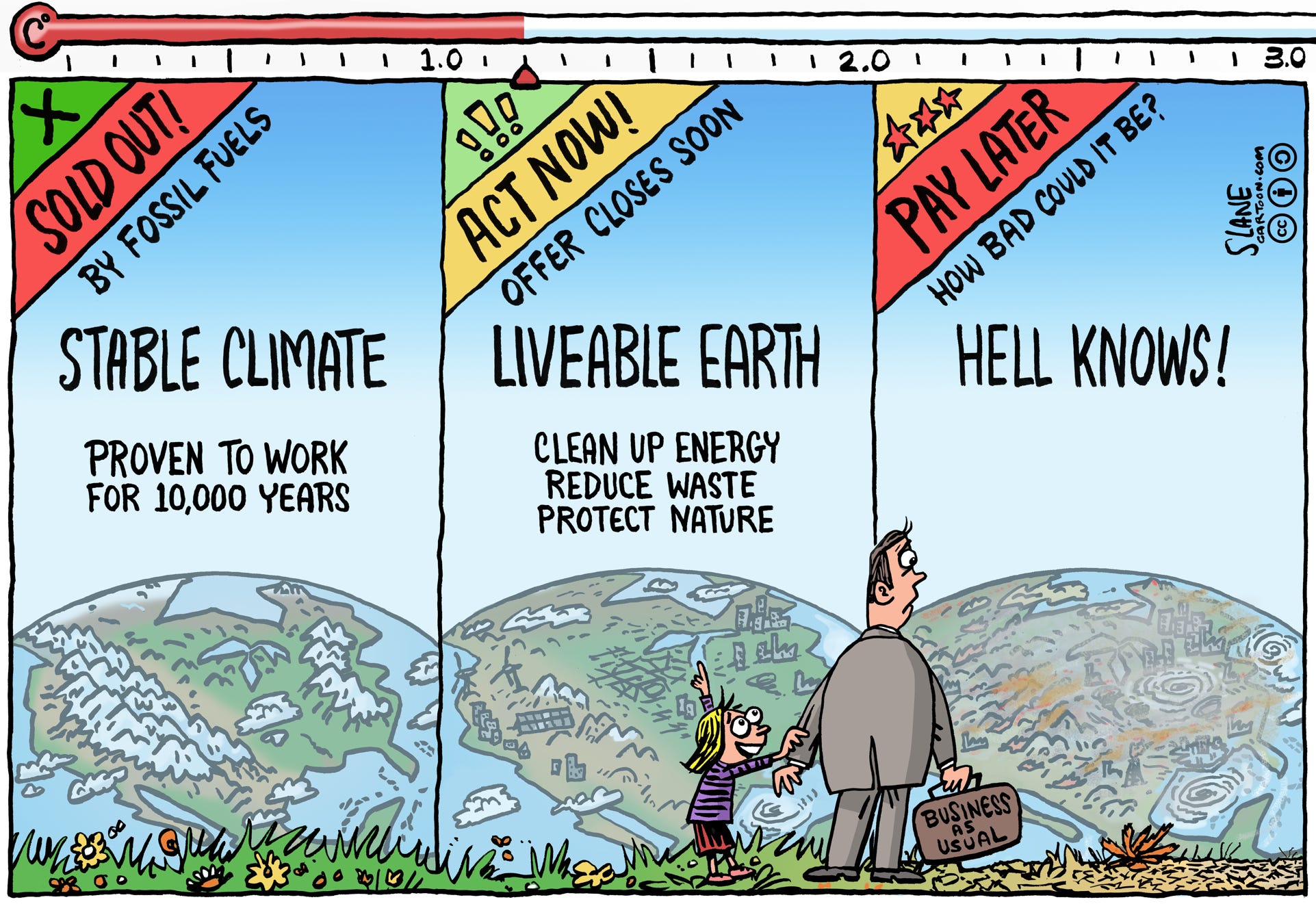
Choosing livable degrees now is a great investment in an economic future. Here we discuss how climate change helps with decent jobs, reduces the cost of living, enhances food security, promotes health & safety, and preserves freedom.
Climate action saves jobs.
That means opportunity, and it means paying the bills.
Good jobs provide one way for us contribute to society and earn a living. Decent work is critical for fair opportunity and a productive economy that gets things done.
Economists say that heating beyond 2°C will cost us more money than taking action. Economic harm means less jobs. The evidence is the economy has the best chance to create opportunities for all of us if we keep the heating well under 2°C.
Today, we are already at 1.2°C of unnatural heating because of fossil fuels and other sources of greenhouse gas emissions. We need to act now.
More frequent and intense heat already undermines decent work in many parts of the world. Too much heat makes for intolerable working conditions outdoors and in uncooled buildings. Working in high temperatures can kill, and we are seeing extreme heat more often.
Reductions in workable hours mean reductions in productivity, incomes, and employment. The International Labour Organization says we can expect a reduction in workable hours of 2% by 2030, even with just 1.5°C of heating. That’s lost work worth trillions of dollars. Each year.
Heating our earth with fossil fuels and other sources of greenhouse gas emissions will cause millions more people to have unsafe working conditions or become unemployed if we keep going the way we are now.
It’s not just those who work outdoors. Reduced productivity at the foundation of the economy will have an impact on everyone’s job security as people struggle with scarcity and higher costs for essentials, while paying for the risk and damage of unprecedented weather.
Taking climate action is taking action for an economy in which everyone can find decent work and thrive.
Climate action cuts inflation.
Climate action makes a good life more affordable.
The money we earn doesn’t go as far when prices rise. Someone needs to pay when unnatural weather harms food supplies or damages infrastructure, and it’ll hit us as inflation or taxes. To reduce inflation and taxes we need to take on the root cause.
At just 1.2°C of unnatural warming, we have seen towns overcome by wildfires. Homes and roads have been destroyed by floods. We do the right thing with emergency assistance, but someone needs to pay for it.
Insurers are raising premiums and refusing to cover farms, homes, and businesses that are in danger because of fossil fuels. That makes it harder to get loans and compensation for losses.
Lumber has become scarcer because of beetles eating up forests that are now warm enough for them to thrive. That makes it harder to build affordable homes.
We are seeing crops withered by extreme weather, and livestock dying or culled because of drought. That means less food, and what’s left will cost us more.
Fossil fuel prices are through the roof and it’s costing everyone. When filling the car, heating our homes, and paying higher prices because of the energy that’s needed to make nearly everything we buy. Cleaning up energy and reducing waste will cut those costs.
Through inflation, our needless addiction to fossil fuels is destroying wealth and devaluing incomes. As Margaret Thatcher said, "Inflation is the parent of unemployment and the unseen robber of those who have saved."
Taking climate action is taking action to reduce inflation.
Climate action helps farmers.
Climate action enhances food security. Food security is at the heart of a good life. We need to be able to eat, to eat good food, and for it to be affordable.
When food security is lost, safety and political stability rarely last long.
At just 1.2°C of unnatural warming, we have a terrible megadrought in the western US. Heatwaves and floods are happening in many of the world’s breadbaskets in the same year.
In 2022, the Po River is dry in Italy’s breadbasket. India banned wheat exports after crops were damaged by heat. France recorded its smallest wine harvest since 1957. Salmon farms in New Zealand are being forced to close. Aflatoxin threatens US corn crops. The list goes on.
For now, innovation, machinery, and fertilizer make up for some of it, at a cost. Still we are losing food and livestock because of fossil fuels side effects. That means scarcity or even starvation in some parts of the world, and higher prices for the rest of us.
Business as usual has us speeding towards 3°C of warming. No one knows if we could still feed the world at 3°C of warming, or at what cost. It’s a dangerous road, turning today’s farmlands into dust.
Taking climate action is taking action for a world in which everyone can find affordable & nutritious food to eat.
Climate action promotes health & safety.
We need climate action to protect people's livelihoods and the world's natural resources that our health and safety depend on.
When someone can’t farm their land because it no longer supports crops, they’ll come looking for work to survive. When someone’s home has been destroyed by a flood or a fire, they’ll come looking for a new place to live.
Heating our earth with fossil fuels and other sources of greenhouse gas emissions will cause millions of people to lose their homes and livelihoods, and many will be forced to migrate. This will lead to social and economic changes in countries that receive migrants.
At just 1.2°C of unnatural warming, people in some parts of the world are already suffering terribly. The impact isn’t evenly spread. Migration forced by unnatural heating has already started.
By the end of this decade, the US National Intelligence Estimate about the consequences of heating predicts a high risk of tension from cross-border migration. The report also identifies threats to relations between nations, and high demand for aid and humanitarian relief.
We've talked about jobs, affordability, and food security in this article. People who can’t support themselves are more likely to turn to desperate measures to survive. Unnatural heating that we can still prevent will cause crime, political disruption, and war.
Fossil fuels and other pollution also harm our health and safety more directly. Pollution from fossil fuels prematurely kills millions of people every year. As the unnatural heat goes up, more people are dying from heatwaves, wildfires, and storms.
According to the World Health Organization, climate change is the single biggest health threat facing humanity, and it’s set to become a worldwide crisis.
Taking climate action is taking action to save lives, preserve health, and keep communities safe.
Climate action preserves freedom.
Choosing livable degrees now protects our fundamental human rights.
In this article we've mentioned how unnatural heating is taking away jobs. It’s increasing the cost of living. It’s reducing food security. It’s threatening our safety. Put those together, and it’s clear that “business as usual” threatens our rights and freedoms.
A clean, healthy, and sustainable environment is a human right. Other human rights depend on it. It’s working-class people, and people who live off the land, who are most at risk. People who did the least to cause the problem will suffer enormously. That's unfair and unjust.
According to the United Nations Environmental Program, unnatural heating is the largest, most pervasive threat to the natural environment and human societies the world has ever experienced.
Unnatural heating causes sudden-onset events that pose a direct threat to human lives and safety, as well as more gradual environmental degradation that will undermine access to clean water, food, and other key resources that support human life.
These impacts interfere with fundamental human rights, such as the rights to life, health, water, food, housing, and an adequate standard of living. The opportunity to pursue life, liberty, and happiness depend on these foundations.
In a more direct way, floods block our roads and destroy our infrastructure. Wildfires take our homes away from us. Heatwaves shut down businesses and events while we shelter indoors to keep cool. Unnatural heating is already limiting everyday freedoms to live, work, and play.
Fossil fuels and other greenhouse gas pollution are having a profound effect on the enjoyment of human rights for individuals and communities across the planet.
Every 0.1°C matters. We’re at 1.2°C today. The Paris Agreement was to keep heating well below 2°C. But we’re not on track yet. We need stronger commitments, and we need to be implementing them faster.
Climate action protects our freedom.
The Climate Quest
If we clean up energy, reduce waste, and protect nature:
we will save millions of jobs worldwide,
we can reduce the cost of living,
keep food on the table,
keep our world safer & promote good health, and
promote life, liberty, and the pursuit of happiness.
Climate activists are freedom fighters. Climate activists are humanitarians. Climate activists are heroes.
Join the Climate Quest
License:
Cartoon by Chris Slane (www.slanecartoon.com) - CC BY-SA 4.0
Article by Climate Quest (www.climatequest.info) - CC BY-SA 4.0
what is the theory of anthropogenic global warming ?